Come funziona Radar Casa
Come funziona Radar Casa: il sistema non parte da un modulo. Parte dal dialogo, acquisisce dati, legge l’annuncio, interpreta immagini e omissioni, poi restituisce una scheda decisionale preliminare.
Radar Casa does not start from a form. It starts from dialogue, acquires data, reads the listing, interprets images and omissions, and then produces a preliminary decision sheet.
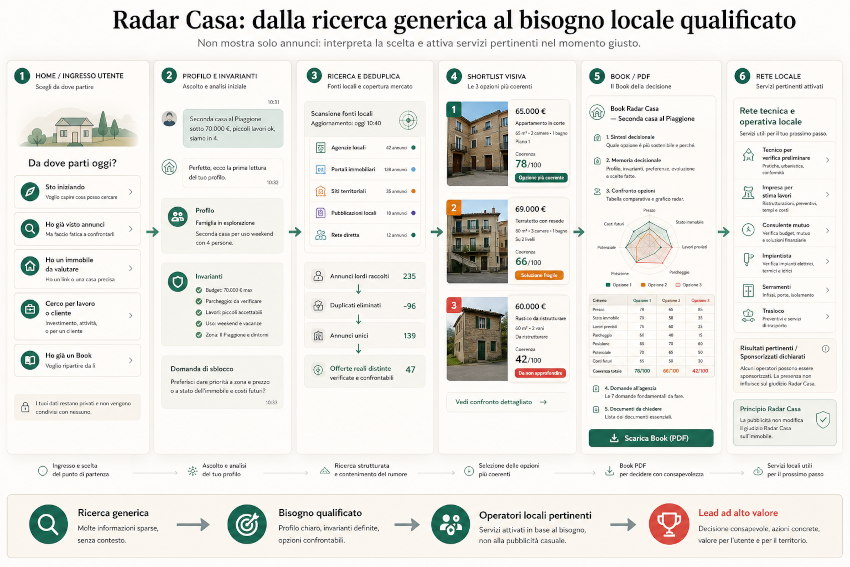
Come funziona Radar Casa: parla prima, ordina dopo
La logica di Radar Casa è chat-first: l’utente non viene trattato come compilatore di un modulo. Racconta cosa cerca, cosa teme, cosa ha visto, quale annuncio lo ha colpito e quali vincoli reali ha.
I dati strutturati servono al sistema, non devono diventare il primo impatto. Il dialogo è la fonte primaria; i campi, le matrici e le schede servono a ordinare ciò che emerge.
Speak first. The system structures later.
Radar Casa follows a chat-first logic: the user is not treated as a form-filler. The starting point is what the person is looking for, what they fear, what they have seen, which listing attracted them and what real constraints they have.
Structured data is useful for the system, but it should not be the first impact. Dialogue is the primary source; fields, matrices and sheets are used to organise what emerges.
Come funziona Radar Casa: dal desiderio alla decisione preliminare
Il flusso non coincide con una semplice analisi di annuncio. Prima viene qualificato il bisogno, poi viene letta l’offerta, poi viene prodotto un esito operativo.
The workflow is not a simple listing review. First the need is qualified, then the offer is read, then an operational outcome is produced.
Casa cercata, uso previsto, paure, aspettative, budget, lavori accettabili.
Invarianti, limiti economici, vincoli personali e soglia di rischio.
Deduplica, confronto, selezione di poche opzioni coerenti.
Testo, immagini, planimetrie commerciali, dati mancanti, dialettica dell’operatore.
Prezzo, lavori, documenti, gestione, servizi, rischio e margine economico.
Tecnico, notaio, impresa, mutuo, impianti, gestione e servizi locali pertinenti.
Restituzione leggibile: sintesi, domande, rischi, documenti, prossima azione.
Visitare, trattare, chiedere documenti, approfondire, sospendere o scartare.
I dati non sono tutti uguali
Capire come funziona Radar Casa significa distinguere il dialogo iniziale, l’annuncio immobiliare, le immagini, i dati mancanti e la successiva scheda decisionale.
Radar Casa distingue ciò che l’utente dichiara, ciò che l’annuncio mostra, ciò che manca e ciò che deve essere verificato con documenti.
Radar Casa distinguishes what the user declares, what the listing shows, what is missing and what must be verified through documents.
Dialogo utente
User dialogue
Desiderio, timori, budget reale, zona, uso previsto, lavori ammessi, vincoli familiari e soglia di rischio.
Annuncio immobiliare
Real estate listing
Titolo, descrizione, prezzo, superficie, località dichiarata, agenzia, dati commerciali e formule narrative.
Immagini e planimetrie
Images and plans
Foto pubblicate, planimetria commerciale, elementi mostrati, elementi non mostrati, coerenze e possibili omissioni.
Come funziona Radar Casa: dalla lettura alla scheda decisionale
Il risultato non è una certificazione tecnica dell’immobile. È un filtro pre-visita o pre-offerta: serve a capire cosa chiedere prima di innamorarsi dell’immobile.
The result is not a technical certification of the property. It is a pre-visit or pre-offer filter: it helps understand what to ask before becoming attached to the property.
Decisione rapida
Quick decision
Conviene andare avanti? Qual è il rischio principale? Il prezzo è ordinario, premium o da difendere con documenti?
Domande operative
Operational questions
Superfici, titoli edilizi, catasto, agibilità, APE, impianti, accessori, vincoli, costi e gestione reale.
Prossima azione
Next action
Visitare con attenzione, chiedere documenti, trattare, impostare condizione, approfondire oppure scartare.
Come funziona Radar Casa nella scheda finale
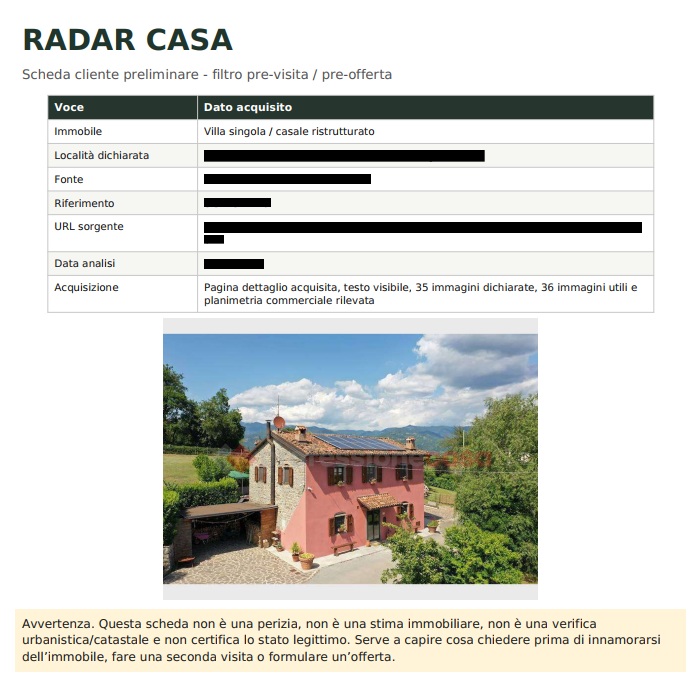
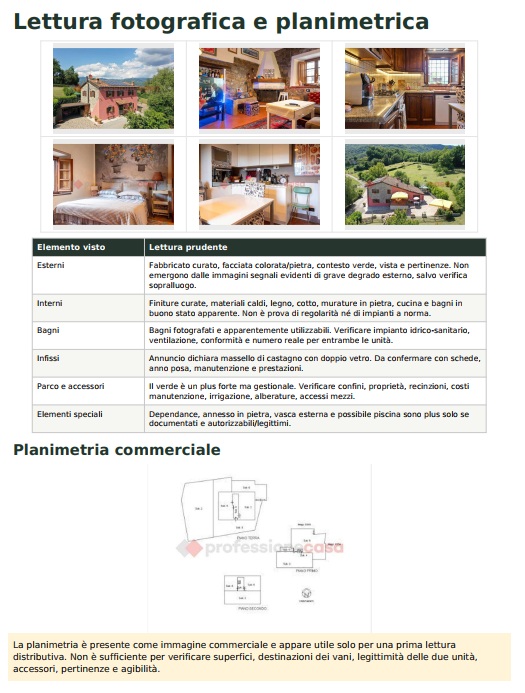
Una scheda Radar Casa trasforma l’annuncio in una griglia di lettura. Non dice semplicemente “bella casa” o “prezzo alto”: separa dati dichiarati, immagini, superfici, accessori, promesse commerciali, documenti mancanti e rischi.
A Radar Casa sheet turns the listing into a structured reading grid. It does not simply say “nice house” or “high price”: it separates declared data, images, surfaces, accessories, commercial promises, missing documents and risks.
- acquisizione dei dati dichiarati nell’annuncio;
- lettura fotografica e planimetrica prudente;
- distinzione tra immagine commerciale e verifica documentale;
- documenti da chiedere prima di procedere;
- checklist per una visita più consapevole;
- limiti dichiarati della scheda preliminare.

Dopo la scheda
La scheda non chiude il percorso. È il cuore del sistema perché crea una base ordinata per la fase successiva.
Anche qui si capisce come funziona Radar Casa: la scheda non chiude il percorso, ma prepara la fase successiva con domande, verifiche e possibili decisioni operative.
Da lì possono nascere azioni diverse: richiesta documenti all’agenzia, visita mirata, confronto con un tecnico, stima dei lavori, verifica dello stato legittimo, trattativa, offerta condizionata o scarto dell’immobile.
After the sheet
The sheet does not close the process. It is the core of the system because it creates an ordered basis for the next phase.
From that point, different actions may follow: requesting documents from the agency, a targeted visit, a technical review, an estimate of works, a legal-building-status check, negotiation, conditional offer or rejection of the property.
Limiti professionali
Radar Casa non è una perizia, non è una stima immobiliare, non è una verifica urbanistica, catastale, strutturale, impiantistica o energetica. Non certifica lo stato legittimo e non sostituisce un incarico tecnico.
Serve a filtrare l’offerta prima della visita, della proposta o dell’incarico tecnico: legge dati dichiarati, immagini, omissioni e fonti disponibili per preparare domande migliori.
Per i riferimenti normativi generali resta utile il portale Normattiva; per le quotazioni immobiliari orientative può essere consultata la banca dati OMI dell’Agenzia delle Entrate.
Professional limits
Radar Casa is not an appraisal, not a property valuation, not an urban-planning, cadastral, structural, systems or energy-performance verification. It does not certify the legal building status and does not replace a technical assignment.
It is a pre-visit, pre-offer and pre-technical-assignment filter: it reads declared data, images, omissions and available sources in order to prepare better questions.
Come funziona Radar Casa: l’annuncio vende, il metodo interroga
Il metodo legge la promessa commerciale, organizza i dati, isola le omissioni, produce una scheda e apre la fase successiva: documenti, visita mirata, trattativa, verifica tecnica o scarto.
The listing sells. Radar Casa questions. The method reads the commercial promise, structures data, isolates omissions, produces a sheet and opens the next phase: documents, targeted visit, negotiation, technical check or rejection.
Radar Casa
Project, purpose and technology
An AI method and prototype to read a home choice before the listing: starting from the person, the territory and the real cost of the decision.
CASA
It does not only search for homes. It reads decisions.
Radar Casa starts from a simple question: even before searching for the right property, are we sure we have truly understood the person who has to choose?
Today the real estate market shows countless listings: price, square metres, area, photos, description, energy class, number of rooms, floor, agency.
These are important data. But they are not always enough to explain why a person stops on one home, rejects another, keeps searching for months or eventually chooses more out of fatigue than conviction.
The problem Radar Casa tries to address
When a person looks for a home, they are not only applying technical filters. Through the words they use, they also reveal what they are trying to protect.
A person may say: “I am looking for a home with a garden”. But behind that sentence there may be very different needs: pets, children, privacy, escape from apartment living, desire for autonomy, need for quiet, fear of noise, the will to put down roots in a place or the search for a new housing identity.
What Radar Casa is
Radar Casa is an AI decision-making filter. Its function is not only to find properties similar to a search.
Its function is to help understand which properties, territories and scenarios are truly compatible with a person, with their goals, with their budget, with their tolerance for risk and with the real cost of the choice.
Person
Desires, fears, priorities, constraints, personal goals and level of maturity of the choice.
Territory
Services, distances, accessibility, quality of life, local activities and real context.
Real cost
Not only price, but works, timing, transformations, management, risk and sustainability.
Why it is not a real estate portal
A real estate portal organizes and displays listings. Radar Casa works on a different level.
It does not replace the portal, the agency, the technician, the bank or the notary. Instead, it tries to build a preliminary reading layer: a space in which the user can better clarify what they are really looking for, what they fear, which compromises they can accept and which checks are necessary.
The hidden language of a real estate listing
Every real estate listing contains a dialectic.
It does not simply show a property: it selects elements, chooses words, organizes photographs, highlights certain aspects and leaves others in the background.
A listing tells a story, but it does not always explain.
It may show a view, a bright room, an architectural detail, a garden, a kitchen, a façade or a location. But it may also avoid what would be decisive to truly understand the property: accesses, relationships with the surroundings, quality of spaces, technical critical issues, distribution limits, probable costs, real transformability, problematic nearby elements or weaknesses that are difficult to declare.
In this sector, the real estate agent and the seller perform a commercial function. They often use their own language, made of recurring formulas, attenuations, omissions, emphasis and images built to direct the buyer’s attention.
This does not necessarily mean deception. It means that the listing is a commercial representation of the property, not a complete reading of the choice.
My professional experience comes from solving concrete real estate problems: irregularities, restrictions, stalled procedures, complex properties, difficult transformations and delicate transactions.
For this reason, when I look at a listing, I do not read only what is declared. I also try to read what remains implicit.
The words used, the photographs chosen, the missing angles, the emphasized features, the descriptive silences and the relationship between property and context can reveal a great deal.
Radar Casa also comes from this ability to read: intercepting the language of the listing, recognizing its commercial logic and helping the user distinguish between story, data, promise, critical issue and necessary verification.
The point is not to distrust every listing. The point is to read it better.
The technology
Radar Casa uses a logic based on conversational artificial intelligence and natural language analysis.
From the user’s language
The system tries to derive declared goals, implicit desires, personal priorities, recurring fears, economic constraints, tolerance for risk and inconsistencies between dream, budget and reality.
To the reading of the scenario
The elements that emerge are related to the property’s characteristics, territory, local services, accessibility, probable costs, possible transformations and risks to be verified.
The goal is not to replace professional expertise, but to better organize the preliminary phase. Radar Casa does not claim to know everything: it tries to build a clearer reading of what often remains scattered.
What it may integrate in the future
The prototype is conceived as a modular structure. In a possible industrial evolution, Radar Casa could interact with different systems and sources.
Real estate data
Listings, portals, market values, OMI data, property characteristics and reports.
Territorial data
Maps, local services, mobility, accessibility, urban context and public information.
Decision-making outputs
Scenarios, comparisons, prudential estimates, PDF reports and more readable choice paths.
The principle remains the same: not to start from data in order to overwhelm the user, but to use data to make the decision more readable.
Project status
Who it may interest
Radar Casa may interest real estate portals, proptech operators, advanced agencies, professional networks, banks and mortgage consultants, territorial actors, home-sector operators, investors and research centres on AI, territory and complex decisions.
The common point is not to sell more properties. The point is to improve the quality of demand: more aware, more readable, more coherent and less scattered.
The relationship with the territory
A home is not an abstract object. It is always within a place. It exists in a street, in a neighbourhood, in a municipality, near or far from schools, work, services, transport, shops, professionals, businesses, cultural places, family networks and daily habits.
The same home may be right for one person and wrong for another. An area may be a limitation, or a resource. A cost may be sustainable for one profile and unsustainable for another.
The vision
Artificial intelligence applied to the home should not be limited to finding more listings. It should help people better understand which choice truly makes sense for their lives.
A home is not a listing. It is a human decision within a real territory.
Contact